
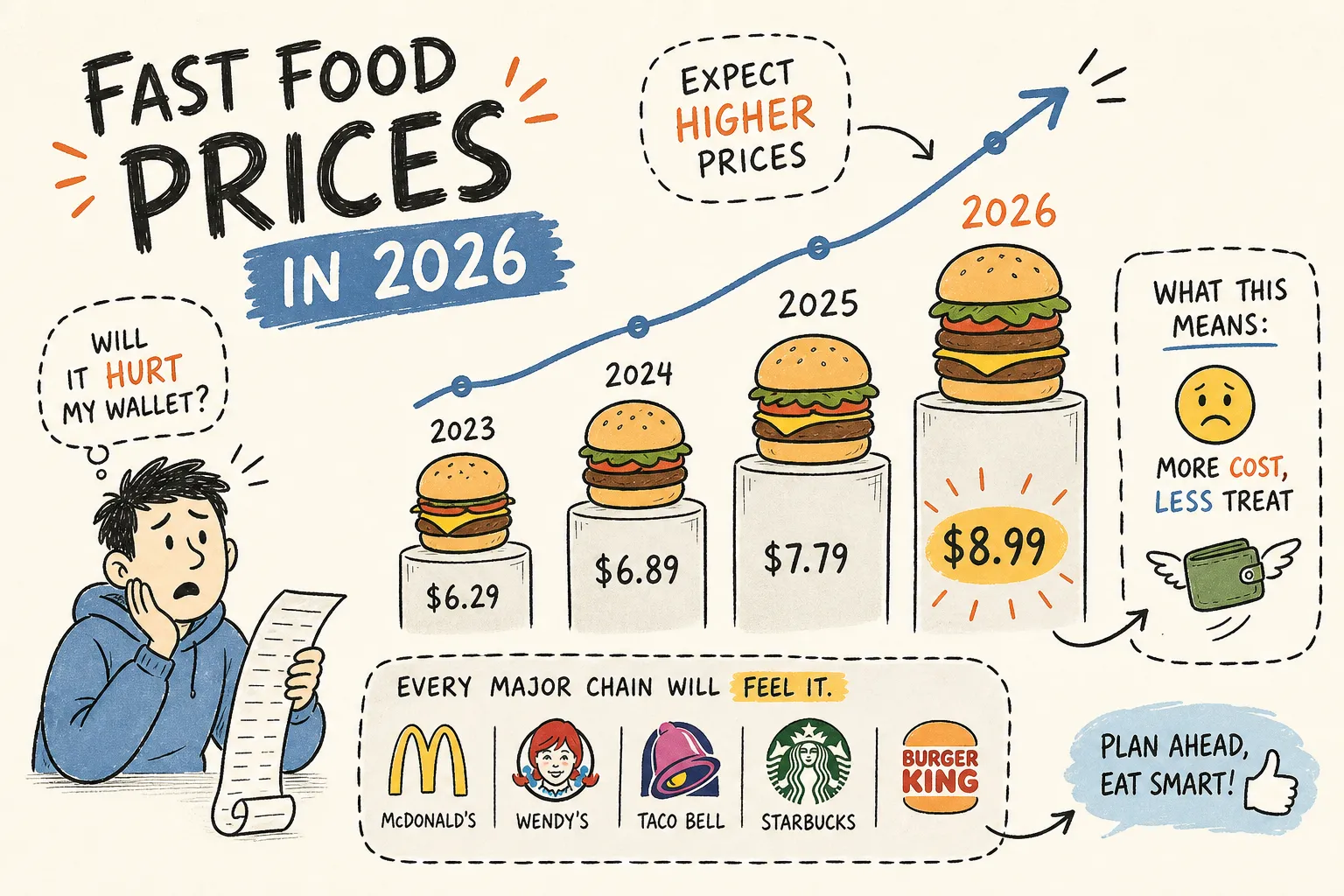
Fast food prices in 2026 have climbed far enough that a quick lunch no longer means a cheap one. Pull up to any major drive-thru and you’ll spend around $12 on average in major metros for a single combo meal, a figure that would have seemed absurd a decade ago.
The national average for a combo meal now sits at approximately $11.56 in major U.S. metros, according to LendingTree data reported by CBS News. That number reflects a fast food landscape where prices have climbed 39% to 100% depending on the chain over the past 10 years, far outpacing general food inflation as measured by the USDA’s Consumer Price Index for food away from home. If you’ve felt the sting at the counter lately, the data backs you up.
This guide breaks down exactly what you’re paying at each major chain, which states charge the most and least, and where genuine value menus still hold up. Platforms like RestaurantMenuList.com track menu prices across hundreds of chains in one place, making it easier to check what you’ll pay before you leave the house. That kind of pre-trip research has gone from a nice-to-have to a real money-saving habit.
What fast food actually costs in 2026
The $11.56 national average for a combo meal is a metro-area figure, so your costs will vary based on where you live. Even outside major cities, fast food prices have climbed well past the $8 to $10 range that felt normal just a few years ago, with sub-$7 full meals at tier-one chains now a rarity rather than the rule.
Burgers and chicken sandwiches at McDonald’s, Wendy’s, and Burger King now typically run $5 to $9 as standalone items in 2026, with prices varying by market and item. Sides and drinks, which once anchored the “under $2” column, now land between $2.50 to $4 at most locations. A combo meal built from individually priced items can easily cross $12 in many markets without a large size upgrade, for example, a mid-tier burger at $7, fries at $3.50, and a drink at $2.50 adds up to $13 before tax.
The drive-thru gap versus delivery is worth noting separately. When you add platform fees, service charges, and tips on a delivery app, which studies on third-party delivery markups consistently show can add $4 to $6 or more to an order, that same $11.56 combo can end up costing $16 to $18 all in. If fast food affordability matters to your budget, ordering in person or through the chain’s own app beats third-party delivery almost every time.
Why fast food prices have climbed so much
Nearly every input cost a fast food franchise carries has gone up simultaneously. Labor, food commodities, packaging, rent, and supply chain friction all moved in the same direction after 2020, and most chains passed those costs directly to diners.
Labor costs drove a significant share of the increase, especially in high-wage states. McDonald’s president Joe Erlinger publicly stated that salary, food, and paper costs surged roughly 40% over five years, which the company cited as the primary reason for menu price increases. California’s $20 minimum wage for fast food workers, enacted in 2024 and now fully in effect, pushed prices an estimated 8% to 14.5% higher at franchised locations, based on a range of economic analyses conducted since the law took effect. Washington and New York have faced similar pressure from state-level wage floors, though comparable multi-state studies are more limited in scope.
Food commodity costs added another layer of pressure. Beef prices rose approximately 22%, pork around 16%, and chicken about 13% during the core post-pandemic inflation window, according to U.S. Chamber of Commerce commodity tracking data. Shortages of aluminum, cardboard, and plastic packaging raised operating overhead further. Franchise owners also faced higher royalty fees and rent increases on renewed or new locations, costs that don’t show up on a commodity index but feed directly into fast food price increases at the store level.
As of April 2026, the National Restaurant Association reported that restaurant menu prices were still rising at about 3.6% year-over-year. The inflation trend has slowed from its 2022 to 2023 peak, but it has not reversed. Expecting prices to fall back to 2019 levels is not a realistic near-term outlook.
Which chains raised fast food prices the most over the last decade
McDonald’s, Taco Bell, and Wendy’s
Not all chains raised prices at the same rate, and the differences are meaningful if you’re choosing where to eat on a budget. McDonald’s leads in long-run price escalation, with average menu prices up approximately 100% from 2014 to 2024. A combo that cost $5 a decade ago effectively became a $10 combo, the steepest climb among major chains and a key reason McDonald’s has faced the most public pushback from cost-conscious customers.
Taco Bell follows with an 81% increase over the same period, a significant climb for a chain that built its identity on being the cheapest option at the food court. Taco Bell still holds an edge on absolute prices, but its move toward mainstream price territory has been steady. Wendy’s and Burger King both raised prices approximately 55% over the decade, landing in the middle of the pack. Subway showed the most restrained increase at roughly 39%, though its customization model makes direct comparisons harder.
How fast food prices compare to broader restaurant inflation
For context, overall U.S. restaurant menu inflation ran about 31% from February 2020 to April 2025, according to National Restaurant Association tracking. Most major fast food chains outpaced that broader benchmark, fast food price increases have not just kept pace with the restaurant industry. They have led it.
Which states pay the most and least at the drive-thru
Fast food prices by state show a clear pattern tied to labor costs and supply logistics. Hawaii leads all states in fast food pricing, driven by import logistics, limited local supply, and high wages. Washington and Alaska rank second and third, both reflecting elevated labor costs and remote supply chain challenges. At the metro level, Seattle and Los Angeles top the city rankings, and six of the 10 most expensive U.S. cities for fast food are located in California, according to 2026 NetCredit data reported by FOX 11.
The price gap between expensive and affordable states is large enough to affect real spending. Regional price comparisons, including NetCredit’s 2026 metro-level study, show price differences of several dollars between high-cost and low-cost markets, with Seattle-area combos running notably higher than those in Southern or Midwestern cities. For travelers or anyone relocating, that difference adds up quickly across a week of meals.
On the affordable end, Mississippi ranks as the most affordable state for fast food according to Food and Wine’s 2026 pricing map, with below-average costs across major chains. West Virginia earns the “least expensive state” distinction in NetCredit’s 2026 study. Both states benefit from lower labor costs and less real estate pressure on franchise locations, and those savings translate directly to lower fast food prices at the counter.
Where your dollar still goes furthest in 2026
Value menus haven’t disappeared, but they require more deliberate searching than they used to. The chains that have kept genuine low-cost options on the menu are the ones where budget-conscious diners should concentrate their spending.
Taco Bell’s Luxe Value Menu remains the most accessible in 2026, with items including the Cheesy Roll-Up at $1.39, the Beefy Potato Loaded Griller at $2.79, and the Cheesy Double Beef Burrito at $2.99. Most items are priced under $3, making it the easiest major chain for eating a full, filling meal without cracking $7. The mix-and-match flexibility helps too: two or three value items can replace a combo meal at roughly half the cost.
Wendy’s Biggie Deals and Everyday Value lineup offers individual items from around $1.79 to $4, with tiered meal bundles at $4, $6, and $8 price points. Wendy’s holds its own on portion size relative to cost, making it a strong choice when you want a more complete meal rather than snack-sized items.
McDonald’s McValue lineup and app-exclusive deals can bring combo meals closer to $5 to $8, but the best savings require using the app and staying current on limited-time offers. KFC’s $5 fill-up bowls deliver solid single-meal value for lunch, and Burger King’s Cravings deals hover around $3 to $5 for value items.
How to check current fast food menu prices before you order
Fast food prices are not uniform across locations. The same chain can charge meaningfully different prices in a downtown location versus a suburban strip mall in the same city, and state-level wage laws create price gaps that persist across franchise groups. Walking in without checking means you might overpay compared to a nearby location or miss an app-exclusive deal that cuts your total by several dollars off your order.
The practical solution is to check prices before you commit to a destination. Most chain apps show current local prices, but jumping between five different apps to compare options is slow. RestaurantMenuList.com consolidates full menus and current prices for hundreds of fast food and casual dining chains in one place. You can look up McDonald’s, Taco Bell, Wendy’s, and regional chains all from a single platform, with menu items, prices, hours, and location details in one browseable profile.
For anyone making fast lunch decisions or comparing options before heading out, that kind of consolidated reference cuts decision time dramatically. Knowing the Taco Bell value menu runs $1.39 to $2.99 before you leave beats discovering a $12-plus combo at the counter. That kind of small information advantage adds up over dozens of meals.
The bottom line on fast food in 2026
Fast food prices in 2026 are meaningfully higher than they were five years ago, and the national average combo meal at $11.56 reflects a sustained structural shift, not a temporary spike. With restaurant menu inflation still running at 3.6% annually, a dramatic reversal is not on the near-term horizon. Eating fast food on a budget now requires more planning than it used to.
The key facts to keep in mind:
- Hawaii, Washington, and California metros are the most expensive regions for fast food prices
- Mississippi and West Virginia offer the most relief on price
- McDonald’s has raised prices the most in long-run percentage terms
- Taco Bell and Wendy’s still offer the strongest value menus, Taco Bell wins on lowest prices, Wendy’s wins on meal completeness
- App deals and value menus at every chain can still cut several dollars off your order if you know where to look
None of this means you’re locked into overpaying. Knowing which chains have genuine value options, which states price meals lower, and where to check fast food prices before you order puts you back in control. For any chain’s full menu and current prices in one place, RestaurantMenuList.com is a reliable starting point for planning a meal that fits your budget before you ever start the car.

Hi! I’m Maherin Akter, and welcome to RestaurantMenuList.com. For the last three years, I’ve been on a mission to explore every flavor I can find sharing everything from my favorite recipes and honest restaurant reviews to deep dives into menu details.